Dear reader, life is too short for crap books.

Thursday, August 24, 2006

Psycho Killer, Quest Que Cest

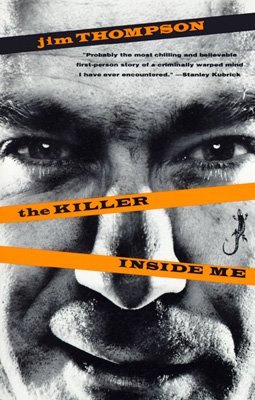
The Killer Inside Me by Jim Thompson

I don't know what my life must have been like before I discovered the Vintage Crime/Black Lizard imprint, but I'm sure it was a dark and empty place. Or rather, it was probably a place filled with books about frustrated English professors and Upper East siders afflicted with ennui, where in the end, things turn out pretty much okay.

Black Lizard puts out everyone from Chester Himes to Joe Lansdale, and has given the work of Jim Thompson the back-in-print with a creepy, noirish cover treatment that it so richly deserves. Thompson is surprisingly under-read, especially considering the fact that he wrote a couple movies for Stanley Kubrick. That aside, he's huge in France.

The Killer Inside Me is the story of a humble Sheriff's deputy in West Texas who is assumed by all to be a little hokey, a little simple-minded, and a little too eager to engage you in cliche-riddled conversation about the weather.

That's just the way he likes it.

In reality, Lou Ford is a seething cauldron of psychosis. He did some stuff when he was younger. He doesn't go into the gory details, but it was pretty bad, and his foster brother took the fall for him. After that, Lou's daddy kept a close eye on him, but then, well, Lou's daddy died, and probably should have known he couldn't keep Lou under wraps in the first place. Because sometimes, Lou sees a woman who reminds him of HER, and when that happens, Lou just can't control what happens next.

It's one thing to read a book about a killer. It's quite another to read a book from the point of view of a killer. Lou's a pretty smart cookie, and is tremendously calculating not only when he's formulating a plan for cold-blooded murder, but also when he's manipulating the people who trust his slow-witted, good-hearted nature.

The murders take place early in the book, and we spend the rest of the time watching Lou try to keep it together. He's a monster, but one so clever and insightful that I defy you to read this book and not find yourself hoping Lou gets away with it at least once.

When a writer can make you think that, well, that writer's pretty good.

If you like...: Ruth Rendell, especially her depiction of a somewhat similar, though less sympathetic psychopath in A Demon in My View, this book is for you.

Tuesday, August 22, 2006

In the Interest of Full Disclosure

As it turns out, I have not actually read everything. In a moment of idle curiosity, I pulled up the Modern Library's list of the100 Best Novels, and discovered that I have only read 22 of them.

I don't know if it makes it better or worse to mention that in addition to those 22, I started 16 of them, but for a variety of reasons (some very good*) didn't finish. Some of these titles I intend to read in the future, but others fall under the umbrella of "I didn't read it in college, and I'm certainly not going to read it now." Henry James, Joseph Conrad, and James Joyce, I'm looking at you.**

___________________
* I was 50 pages from the end of Lolita when some jerk came up to me in the high school library and told me how it ended. I've never had the heart to pick it up since.
** Lest you think I majored in English at some half-baked school that did not require its students to read these venerable gents, I have read at least two books by each James, Conrad, and Joyce, and am somewhat at odds as to determining which of them I hate most although I suspect it's Henry James.

Friday, August 18, 2006

Rich People Died

The Hollywood Book of Death by James Robert Parrish
Killing Yourself to Live: 85% of a True Story by Chuck Klosterman

A few years back, I worked as a volunteer manager for a traveling Titanic exhibit, and each and every weekend, thousands of well-fed tourists poured into the Memphis Pyramid to gawk at stuff, and generally make my life miserable. One day, after a particularly grueling shift during which a visitor handed me a headset, and said, "I threw up on this," I was complaining bitterly to a friend, and asked, "Why? Why do people insist on being interested in this gruesome spectacle?" She shrugged and said, "Rich people died."

And there you have it. So long as rich people die, people will insist on being interested in it, gawking at it, and books will be published about it. Bad experience aside, I am forced to admit that I, being no more noble than anyone else, am also interested in celebrity deaths. And living in Los Angeles, I certainly have access to a number of them. I can go to the Viper Room where River Phoenix overdosed or to the Biltmore Hotel, the last place Elizabeth "The Black Dahlia" Short was seen alive. Heck, if I walk four houses down from mine, I can see up into the apartment where a washed-up silent film star named Karl Dane blew his head off.

The Hollywood Book of Death is pretty straightforward - brief biographies of the famous, the obscure, and the tragic. The book is divided into chapters including "Drugs and Alcohol," "Murders," "Puzzling Deaths," and "Accidental Deaths," but despite its sensational subtitle, "The Bizarre and Often Sordid Passings of More Than 125 American Movie and TV Idols," the biggest hunk of the book is given over to "Natural Causes."

In addition to being sometimes sordid, it's a pretty well-researched little book that includes lots of tidbits I never knew (e.g. John Barrymore's drinking buddies Errol Flynn and Raoul Walsh swiped the body and played a little Weekend At Bernie's with it) and debunks lots of gossip I'd always believed (e.g. Jayne Mansfield was not, in fact, decapitated - her wig came off).

Killing Yourself To Live differs from The Hollywood Book of Death most significantly by not being remotely about what it purports to be about. Theoretically, Klosterman is on assignment with Spin, embarking on a whirlwind road trip across the United States to visit the sites of notable rock n' roll deaths. But pretty quickly, he realizes that nobody at the Chelsea Hotel wants to answer any more questions about what happened between Sid and Nancy in Room 100, that the swamp where Skynyrd's plane went down is infested with cottonmouths, and that when you go to the beanfield where the music died, there's really not a whole lot you can do except stand around in a beanfield.

As a result, Klosterman's whole experiment devolves into a memoir of music he's loved, women he's loved and lost, and sometimes both at the same time. At one point, he realizes that he is best able to understand the role that these women played in his life by casting them as various members of KISS. Hey, we've all done it (although maybe not with KISS).

Is this more than a little self-indulgent? You betcha. Does that make it a bad book? Not by a long shot. Klosterman perfectly captures what it's like to be in your early 20s, and even more perfectly, how hard it is to remember what that time was like once you're no longer in your early 20s, except that it was depressing, spent shiftlessly, and probably wasted on you. The book is quirky and funny, and filled with the kind of thoughts you have on a long car trip by yourself, if you are a music geek. How do I feel about Rod Stewart? Why does everyone go through a Led Zeppelin phase? What motivated Eric Clapton to steal his best friend's wife? Things like that.

If you want a celebrity fix, and are feeling shameless about it, go for The Hollywood Book of Death, but if you want to get some poignant reflection and pop culture nostalgia out of the deal, Killing Yourself To Live should be just the ticket.

Wednesday, August 09, 2006

The Sweet Science

Rope Burns by F.X. Toole

When I read F.X. Toole's author bio, it made me feel a little sheltered and unaccomplished. Check this out: "F.X. Toole was born in 1930. Having worked as a bullfighter, professional boxing "cut man," taxi driver, and saloon keeper, Toole published his first book of fiction at age 70. He died in 2002, before seeing his short story, "Million Dollar Baby" become an Academy Award-winning film."

The man man made Hemingway look like a hare-lipped file clerk.

The stories in Rope Burns are equally tough and gritty, without being sordid. A good boxing story can never be sordid, because boxing has honor, and even if the other guy has you bleeding from the eyes, it's still not okay to rabbit punch him. The way that the trainers in Toole's stories teach their boxers the code of the fight is inspiring without being cheesy.

Toole's protagonists are always the good guys, and whether they're wearing the gloves, sealing up the cuts, or shouting advice from the corner, they're facing off against a ready-made villain, the opponent. There are lots of ways to be a boxing hero, and just as many to be a boxing villain - when you have those dynamics going for you, sometimes you don't even need much more in the way of a plot. Three rounds of boxing can pack in as much high drama and character tension, and as many plot twists as Macbeth.

While "Million Dollar Baby" may be the book's well, million dollar baby, my money's on "The Monkey Look," a clever story about a "cut man" who gets even. Also good is the title story, a novella about a trainer struggling to beat dirty odds and get his fighter to the Olympics.

If you liked...: The Pugilist At Rest by Thom Jones or Friday Night Lights by H.G. Bissinger, this book is for you.

Sunday, August 06, 2006

Lunchtime Poll

For absolutely no good reason:

1. Which two characters should die in the last Harry Potter book?

2. David Sedaris: continuing to produce a fine body of funny, touching work? coasting by on acclaim from his early works? overrated from the start? other?

3. Most entertaining and/or egregious literary scandal of the year: James Frey, JT LeRoy, or Kaavya Viswanathan?

4. Best book you've read so far this year.

Wednesday, August 02, 2006

Mazer Rackham Built My Hot Rod

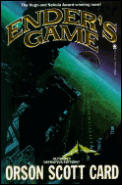
Ender's Game by Orson Scott Card

"General Levy has no pity for anyone. All the videos say so. But don't hurt this boy."
"Are you joking?"
"I mean, don't hurt him more than you have to."


MM: When I began the "Great Science Fiction Odyssey of 2006," Brady was like, "Ooh, ooh, ooh. This one, this one." And having not been led astray by him with Isaac Asimov, I took it. And the next few days are kind of a blur. I read this book on the bus, while eating dinner, and really, any moment that I was not otherwise engaged in paid labor or unconsciousness.

To sum up, a generation or two before our story begins, an alien race (known throughout the book as 'buggers') darn near wiped out earth, and the only thing that prevented its utter annihilation was the quick-thinking action of a young fleet commander named Mazer Rackham (truly a name worthy of Airwolf). The leaders of Earth know they got incredibly lucky with Rackham, and immediately set about preparing an elite command for the next invasion. They monitor small children, plucking up the ones that show an aptitude for military leadership, and ship them off to Battle School, where they spend a few years leading platoons and zapping each other with freeze rays in zero gravity war scenarios.

As you might imagine, this can really mess a little kid up. Some of the kids rise to the occasion, some are broken beyond repair, and some become psychotic little monsters. Enter Ender.

BP: Ender is kind of a eugenics Goldilocks. His parents, having good genes, were - depite an overpopulation problem - allowed to have 3 kids. Their first, Peter, was too psychotic. Their second, Valentine, was too kind. Ender, on the other hand, is juuuust right. They figure this out when, having been hit by a bully, Ender knocks him flat and then beats him to a pulp while he is down. Peter would have killed him, Valentine would have turned the other cheek, but Ender knew that preventing further reprisals meant dirty pool, as it were. What makes Ender sympathetic is that knows that, even though he was (tactically) right he also knows that he was wrong to do it.

The majority of the book is taken up with Ender's time in Battle School, where he is jumped through hoop after hoop. You'd think this would get boring, but it doesn't. On the one hand, Ender is such a strategist that it's hard to imagine him losing a scenario. On the other hand, the fate of the human race is at stake and his officers stoop to unbelievable depths to try and humiliate, defeat, and break a six year old. Ender makes friends? Turn them against him. Ender wins scenarios? Change the rules. Ender still wins and gets respect? Use it to isolate him. By the time he's ten, and shipped off to Command School, Ender is edging towards the kind of stoic loneliness and isolation of world savior types like, say, a fully grown Superman.

MM: Sometimes it's easy to forget that Ender's just a little boy, much younger, yet somehow much more together than Peter Parker ever managed to be. But even though Ender's brain is pretty much adult from the beginning, Card still manages to trace his maturation, charting some kind of childhood development for a childhood that has certainly never existed. Watching Ender grow up is one of the best - and most tragic- things about the book.

As Brady mentioned, the non-stop war room scenarios should get tedious, but don't. This is because, on top of the increasing inventiveness of each series of battle tactics, there's also a side plot on Earth, involving the seriously creepy Peter and the logical, yet emotional Valentine (imagine if Hermione was a Vulcan). I won't tell you much, but the side plot later ties in rather importantly to the larger story, and it involves a pair of adolescents hatching a plan for world domination. They're Ender's siblings... so you know they'll probably come up with something interesting.

BP: To say more would be criminal, as there are a few late in the game twists that ratchet up the emotional heft of Ender's plight without sacrificing the momentum of the plot. Though I figured out relatively quickly that Verbal Kent was Keyzer Soze and that Bruce Willis had already taken the big dirt nap, I had to backtrack a few pages in several cases: the text had me reading so fast I did the mental equivalent of a double-take, and then had to go back and make sure I hadn't misread something.

After the last "Mary Meets The Spacemen," Mary remarked that it was a shame that some people respond to stories like these by saying they're too far-fetched, or not real enough. My response was "Yeah, because that family in The Corrections really existed." But if I had to locate this book in the realm of more ostensibly realist fiction, I'd call it a boarding school coming-of-age: something like A Separate Peace, or maybe even Ferrol Sams's The Whisper of the River, with a dash of Lord of the Flies thrown in.

And spaceships.
Tuesday, August 01, 2006

Still, You Won't Catch Me Reading the One Where the Amish Woman Solves Crime

Case Histories by Kate Atkinson

Lately, I realize that this blog has become very heavy on the detective stories. I can't help it... I've been on a serious kick. And I recently finished re-reading the book that was responsible for it all.

You see, about two years ago, I was the kind of person who made fun of mystery novels, and believed that to enjoy them, one must be a possessed of a deep love of tea, gardening, badminton, and brisk nature walks. Then I read Case Histories, which was cleverly disguised as a regular novel, without any of the trappings that make mystery novels as easy to identify from a distance as a Sophie Kinsella book.

Quickly, I realized I was reading a fairly disturbing mystery novel, one that digs up three long-forgotten murder cases, and through a sequence of events, places them in the hands of one Jackson Brodie. Brodie is, on the surface, a lot like your typical detective - he smokes, drinks, is unlucky in love, and gets beaten up a lot. However, unlike your typical detective, he adores Emmylou Harris and Lucinda Williams, is kind to elderly cat-obsessed women, and is a doting, slightly overprotective father.

Yet "good" as Jackson is, his smarts and a certain toughness keep him from being a complete sap. And the way that Atkinson teases out clues from decades-old unsolved, unrelated crimes is utterly tantalizing. One missing toddler, one teenage girl knifed down in her father's office, and one murdering mama = whoa... didn't see that coming.

From that point on, I was hooked, and would go on to read Patricia Highsmith, Ruth Rendell, and Patricia Cornwell. Still haven't picked up one of those P is for Patricide books, or whatever, but I hear they're better than they look.