So, during the odious Game 5 of the NLCS in which our beloved Dodgers had their clocks collectively cleaned, we did find a moment to remark on Casey Blake's choice of at-bat music, as the Bearded One seemed to have selected some sort of emo rocker tune.
This was odd. More research was needed.
But fortunately, an enterprising soul has put together a list of off-beat at-bat music selections throughout MLB. And boy, oh boy, there are some doozies there.
For starters, since it was him that inspired me to track this down: Casey? The Killers? Really?
However, this was not the most egregious song choice on the list. Anyone who gets pumped up by the musical stylings of Creed or Collective Soul does not deserve to have music in their lives. Tom Glavine and Manny Delcarmen, I'm talking to you. And AJ Burnett, "Hangin' Tough?" Are you a 13-year-old girl circa 1990?
But there are some choice selections. Jeremy Sowers of the Cleveland Indians favors the Wilco tune, "Pot Kettle Black," Rich Aurilia of the Giants likes "No Sleep Till Brooklyn," and Jimmy Gobble of the Kansas City Royals has selected "Copperhead Road" by Steve Earle.
However, the best song on the list by far goes to Jed Lowrie of the Boston Red Sox, and it causes me pain to say something nice about the Red Sox, but when your at-bat music is "Teenage Kicks" by The Undertones, all I can say is, sir, you win the prize for being cool.
As for myself, I've given the matter a lot of thought, and if, after the apocalypse, I find myself somehow qualified to play on a Major League team, my at-bat music would be "Wreck My Flow" by The Dirtbombs.
Also, "Debaser" would be cool.
So, what's your at-bat music?
Showing posts with label Sports. Show all posts
Showing posts with label Sports. Show all posts
Saturday, October 18, 2008

Sunday, October 12, 2008
Speaking of Poetry and Baseball. . .
John Newbery's 1744 children's book, A Little Pretty Pocket-Book, intended for the Amusement of Little Master Tommy and Pretty Miss Polly with Two Letters from Jack the Giant Killer, reminds us that B is, of course, for Baseball.*

And maybe it's just because I've been reading Michael Billig's Banal Nationalism, but the "moral" linking British mercantilism to base running is cracking me up something fierce.
---------------------
*Also, recall the wisdom of Uncle Shelby: "X is for xylophone, because X is always for xylophone."

And maybe it's just because I've been reading Michael Billig's Banal Nationalism, but the "moral" linking British mercantilism to base running is cracking me up something fierce.
---------------------
*Also, recall the wisdom of Uncle Shelby: "X is for xylophone, because X is always for xylophone."
Friday, October 10, 2008
The Extemporaneous Poetry of Vin Scully
We've been slack of late, I know. The reason? The Dodgers.
Apropos of the playoffs, the other night Mary and I were discussing whose jersey we would purchase, were we so inclined (and moneyed - those things are like 200 bucks, and that's cash that could be better spent on tickets). Mary was leaning towards Garciaparra - a classy guy, indeed - but there's only one name I'd want on mine: Scully. He is, after all, the poet laureate of baseball and one of the patron saints of this blog.

Seriously, imagine for a moment the yarns that would be spun at a dinner party made up of Vin Scully, Eugene Walter, Everette Maddox, and Elaine Dundy. The mind boggles.
Some might deride ol' Vin for rambling on at times, being too "flowery", or talking too much.
Heathens, all.
Consider this, from the third and final game against the Cubs last week:
(transcript via LAist - we were too busy gnawing our fingernails off to take such good notes)
I swear, the man's voice is a time machine that takes me back to the years before steroids, ridiculous salaries, and the @)#&^% designated hitter.
So in the spirit of October goodness, here's Vin Scully's play-by-play for Sandy Koufax's perfect game in 1965 against the Cubs.
And better still, here's audio of Vin calling Hammerin' Hank Aaron's big hit - he starts at about 54 seconds in, after two lesser broadcasters whoop it up for a bit.
Apropos of the playoffs, the other night Mary and I were discussing whose jersey we would purchase, were we so inclined (and moneyed - those things are like 200 bucks, and that's cash that could be better spent on tickets). Mary was leaning towards Garciaparra - a classy guy, indeed - but there's only one name I'd want on mine: Scully. He is, after all, the poet laureate of baseball and one of the patron saints of this blog.

Seriously, imagine for a moment the yarns that would be spun at a dinner party made up of Vin Scully, Eugene Walter, Everette Maddox, and Elaine Dundy. The mind boggles.
Some might deride ol' Vin for rambling on at times, being too "flowery", or talking too much.
Heathens, all.
Consider this, from the third and final game against the Cubs last week:
(transcript via LAist - we were too busy gnawing our fingernails off to take such good notes)
"And the Dodgers are one out away. One sweet beautiful marvelous out away. They will take it any way shape or form. Strike out, ground ball, fly ball, fair ball, line drive, any way they can get their hands on it. That precious thing called the final out.
Broxton delivers, swung on and missed. And now it’s not one sweet precious out, it’s one sweet precious pitch. Listen to this crowd.
No balls and two strikes to Soriano. Broxton ready. Half swing strike three called and the Cubs are dead! [...]
And as the Dodgers mob each other traditionally out in front of the mound, the lost Cubs - a lot of them, Aramis Ramirez, Derrek Lee - sitting motionless in the dugout, just staring like kids outside a candy store or like the uninvited to the party. Just staring, waiting, watching, knowing there’s nothing left but go back to the dressing room and fly back to a disappointed Chicago."
I swear, the man's voice is a time machine that takes me back to the years before steroids, ridiculous salaries, and the @)#&^% designated hitter.
So in the spirit of October goodness, here's Vin Scully's play-by-play for Sandy Koufax's perfect game in 1965 against the Cubs.
And better still, here's audio of Vin calling Hammerin' Hank Aaron's big hit - he starts at about 54 seconds in, after two lesser broadcasters whoop it up for a bit.
Thursday, October 02, 2008
No Doubt About It

Apparently, today is going to be a day where I write about everything except books.
I just heard that Lanny Frattare, the voice of the Pittsburgh Pirates for 33 years, is retiring.
Frattare is a big part of the reason I'm a baseball fan today, partly because I used to listen to him on the radio, and partly because he signed a baseball for me.
But mostly, it's because he was once very nice to my mom. I wrote that story down about a year ago, and you can read it here.
Wednesday, September 10, 2008
To Acquire a Void: What I Talk About When I Talk About Running by Haruki Murakami

What I Talk About When I Talk About Running: A Memoir by Haruki Murakami
Though running marathons and writing novels require a similar skill set, people respond very differently when you tell them you do one or the other. Tell people you've written a novel, and they will likely be impressed, as it's something that a good number of people wish they could do themselves. Tell them you run marathons, and they will also be impressed; however, it will be as though you've told them that you hold the Guinness World Record for being covered in bees. They may think your accomplishment impressive, but also slightly insane and pointless.
As Murakami writes, "I've never recommended running to others... a person doesn't become a runner because someone recommends it. People basically become runners because they're meant to."
For over twenty years, Murakami has run for an hour nearly every day, more if he's training for a marathon, which he does once a year. In recent years, he's added triathlons to his repertoire. And on top of that, he's also one of Japan's most celebrated and inventive authors, his work translated into 42 languages.
The book is less a collection of essays than journal entries, in which Murakami describes how he got into distance running at around the same time he decided to become a novelist. In some sections, he's talking about writing, in others, he's talking about running, but really, he's always talking about both -- and in doing so, he's talking about the kind of life that he's chosen to live.
Some things have fallen by the wayside, like the late night social life he enjoyed as the owner of a Tokyo jazz bar in the early 80s. It's a solitary, contemplative life, but he's found that it suits him.
Writing takes talent, which he acknowledges, cannot be acquired; however, it also takes focus and endurance, which can be. You can't run without these things, and you can't write without them either. In fact, he says, "Most of what I know about writing I've learned through running every day."
As a distance runner (and a modestly unsuccessful writer), I found Murakami's observations both immediately familiar and reassuring. People often ask me what I think about when I'm running, how I keep myself from getting bored. I've always had trouble answering this question, because although running keeps my mind occupied and focused, I'm never quite sure what it's focused towards.
Murakami writes about this, saying,
"But really as I run, I don't think much of anything worth mentioning. I just run. I run in a void. Or maybe I should put it the other way: I run in order to acquire a void... As I run I tell myself to think of a river. And clouds. But essentially I'm not thinking of a thing. All I do is keep on running in my own cozy, homemade void, my own nostalgic silence. And this is a pretty wonderful thing. No matter what anybody else says."
It is a pretty wonderful thing, and a pretty wonderful way of talking about it.
If you liked...: On Writing by Stephen King, and/or if you're a distance runner, this book is for you.
Sunday, September 07, 2008
Refreshing! A Girly Book That Isn't Girly: It Takes More Than Balls

It Takes More Than Balls: The Savvy Girls' Guide to Understanding and Enjoying Baseball by Deidre Silva and Jackie Koney
Before he asked me if I wanted to do "dueling reviews" of It Takes More Than Balls, I'd always thought that Bob (he who mans The Griddle at Baseball Toaster) had a possibly unhealthy obsession with tracking instances of catcher's interference.
But thanks to Silva and Koney's book, I now know what it is, and more importantly, why it is interesting.* So, Bob, I'm sorry I doubted you.
It Takes More Than Balls is a concise, entertaining, and snarkily written overview of the sport and how it's played. Silva and Koney do a nice job of illustrating different aspects of the game, as well as the characteristics that separate the good from the great players, with examples plucked from all eras of baseball history.
There's the heartwarming story of Connie Mack agreeing to start aging pitcher Howard "Bob" Ehmke in the first game of the 1929 World Series after Ehmke said, "Mr. Mack, there is one great game left in this old arm." And sure enough, there was. And I couldn't help but feel a little twinge of respect for scrappy Pete Rose, who I learned routinely sprinted to first base when he got a walk, just like the coaches made us do in Little League.
But it's not all heartstrings and the soundtrack from The Natural. Silva and Koney also get in some nice digs at Manny, A-Rod, and the home run derby steroid sluggers, and have a good time (if a kinder one) rolling out stories of notorious errors, regrettable trades, and player foibles.
I do have one small beef with the book, which is that I'm not sure which part of it is for "savvy girls." This really has more to do with the book's packaging, as I really appreciated the absence of overtly girly content in Silva and Koney's approach. No "Omigod, my boyfriend is so into baseball, and I so totally do not know what is going on!" moments -- they respect their readers' intelligence and interest in the sport. However, aside from the memories and testimonials shared by female fans at the end of each chapter (most of which are horribly bland), this is really a book for any casual, yet enthusiastic baseball fan.
I enjoyed it, learned a few new things, lapped up some interesting baseball stats and stories, and was able to add a new piece of ammo to my unwavering, semi-irrational argument that the National League is superior to the American League.**
However, most "savvy guys" won't, because they will not buy a book with a pink cover and a title like It Takes More Than Balls.
I don't blame Silva and Koney for this -- I blame their publisher. And society.
_____________________
*Baseball-Reference.com describes catcher's interference as "a situation where the catcher hinders a batter's ability to hit a pitched ball by touching his bat. The call is automatic as long as the batter was standing inside the batter's box, as it is considered the catcher's responsibility to place himself so as to allow sufficient space for the batter to swing the bat unimpeded."
That is well and good, but I prefer the way the ladies describe it: "The batter is given first base, while the catcher is left writhing on the ground wondering why he didn't become a dentist, like his mother wanted."
**I will fight with total strangers about this. This, and my equally unwavering, semi-irrational argument in favor of "Sweet Child O' Mine" over "Welcome to the Jungle" as the superior GNR song.
Sunday, July 13, 2008
A Baseball Top 10 and Bottom 5
We here at the blog have been attending Dodgers games like mad this month, thanks to a massive sale on tickets. Seats that would ordinarily cost $30 were going for $6, so we took advantage. Baseball on tv is okay, but there's something about going in person... mostly good and a few bad.
Favorite things about baseball games:
1. Heckling
2. Base stealing
3. the Kiss Cam
4. Double plays
5. Dodger Dogs
6. Hero/villain players (the Nomar Garciaparra/Andruw Jones effect)
7. Watching pitchers bat
8. Odd facts learned about players on the Jumbotron (did you know that Paul Hoover is fluent in American Sign Language?)
9. High-fiving strangers
10. singing "Take Me Out to the Ballgame" as loud and off-key as I can
Least favorite things about baseball games:
1. the Wave
2. People who get up in the middle of every inning to get food
3. Walks
4. Foul balls
(#3 and #4 tend to lead to increased instances of #1 and #2)
5. When the person who sings the National Anthem goes for the extra high note on "land of the free"
Favorite things about baseball games:
1. Heckling
2. Base stealing
3. the Kiss Cam
4. Double plays
5. Dodger Dogs
6. Hero/villain players (the Nomar Garciaparra/Andruw Jones effect)
7. Watching pitchers bat
8. Odd facts learned about players on the Jumbotron (did you know that Paul Hoover is fluent in American Sign Language?)
9. High-fiving strangers
10. singing "Take Me Out to the Ballgame" as loud and off-key as I can
Least favorite things about baseball games:
1. the Wave
2. People who get up in the middle of every inning to get food
3. Walks
4. Foul balls
(#3 and #4 tend to lead to increased instances of #1 and #2)
5. When the person who sings the National Anthem goes for the extra high note on "land of the free"
Sunday, June 08, 2008
Don't Diss My Dodger Dogs
This weekend, the NYT's Peter Meehan wrote an ambitious and cholesterol-packed feature on the highlights and atrocities of ballpark cuisine, complete with a super cool, drool-inducing interactive map laying out best and worst bets at 30 major league baseball stadiums.
DO NOT look at this right before lunch, as even the plastic cheese nachos and soggy BBQ sandwiches will start to look good to you.
 While I was not particularly astonished that Dodger Stadium didn't come out on top, I was horrified by Meehan's description of the park's legendary Dodger Dog as "contemptibly bad (salty, greasy and tepid)."
I beg to differ, as Dodger Dog cravings carry considerable weight each time Potts and I debate whether to shell out the dough to attend a Dodgers game. I've never found a Dodger Dog to be either greasy or tepid, and aren't hot dogs supposed to be salty?
Meehan's winning stadiums include San Francisco, Seattle, and Milwaukee, and while I can vouch for the bratwurst at Brewer Park, I suspect our palettes may differ somewhat. The Seattle Sea-Dog (a cod hot dog), which he loved, sounds like poison to me, and I would never, ever in a million years eat sushi at a ballpark unless I was in Japan.
Alongside Los Angeles, Chicago, and Baltimore fared poorly with a crab cake sandwich at Oriole Park written up as "the worst dish I had the displeasure of sampling at a ballpark."
After checking out the map, though, I'm suddenly inspired to travel to St. Louis for the sole purpose of going to Busch Stadium for a "bratzel," a bratwurst wrapped in a pretzel and served with spicy mustard. I looked at a picture of it over 12 hours ago, and haven't stopped thinking about the yummy-looking thing since.
DO NOT look at this right before lunch, as even the plastic cheese nachos and soggy BBQ sandwiches will start to look good to you.
 While I was not particularly astonished that Dodger Stadium didn't come out on top, I was horrified by Meehan's description of the park's legendary Dodger Dog as "contemptibly bad (salty, greasy and tepid)."
I beg to differ, as Dodger Dog cravings carry considerable weight each time Potts and I debate whether to shell out the dough to attend a Dodgers game. I've never found a Dodger Dog to be either greasy or tepid, and aren't hot dogs supposed to be salty?
Meehan's winning stadiums include San Francisco, Seattle, and Milwaukee, and while I can vouch for the bratwurst at Brewer Park, I suspect our palettes may differ somewhat. The Seattle Sea-Dog (a cod hot dog), which he loved, sounds like poison to me, and I would never, ever in a million years eat sushi at a ballpark unless I was in Japan.
Alongside Los Angeles, Chicago, and Baltimore fared poorly with a crab cake sandwich at Oriole Park written up as "the worst dish I had the displeasure of sampling at a ballpark."
After checking out the map, though, I'm suddenly inspired to travel to St. Louis for the sole purpose of going to Busch Stadium for a "bratzel," a bratwurst wrapped in a pretzel and served with spicy mustard. I looked at a picture of it over 12 hours ago, and haven't stopped thinking about the yummy-looking thing since.
Wednesday, April 30, 2008
Great Baseball Reads from Them in the Know
If you're interested in books about baseball, there are a ton of them listed today at Baseball Toaster.
Bob weighs in with his top ten list, and has never once steered me towards a baseball book that I haven't loved (The Soul of Baseball: A Road Trip Through Buck O'Neil's America and The Pitch That Killed: The Story of Carl Mays, Ray Chapman, and the Pennant Race of 1920).
Now I just need to buckle down and read that big, fat, scary-looking Branch Rickey biography.
Bob weighs in with his top ten list, and has never once steered me towards a baseball book that I haven't loved (The Soul of Baseball: A Road Trip Through Buck O'Neil's America and The Pitch That Killed: The Story of Carl Mays, Ray Chapman, and the Pennant Race of 1920).
Now I just need to buckle down and read that big, fat, scary-looking Branch Rickey biography.
Wednesday, January 16, 2008
The Amazing Bunion Derby of 1928
 C.C. Pyle's Amazing Foot Race: The True Story of the 1928 Coast-to-Coast Run Across America by Geoff Williams
I spent New Year's Day 2007 running 12 miles from one end of Dauphin Island to the other. And I spent the first day of 2008 finishing Geoff Williams's utterly charming book about a crew of guys who would have viewed a 12 mile run as a picnic.
Sometime in 1927 (a year I know far too much about), the "P.T. Barnum of sports promotion," C.C. Pyle, cooked up a scheme for the marathon to end all marathons, from Los Angeles to New York City with a $25,000 prize to the first finisher. 199 runners from around the world paid their $125 entry fee for C.C. Pyle's First Annual International Transcontinental Foot Race, dubbed the Bunion Derby, and set out on March 4, 1928. Astonishingly, despite inclement weather, poor footwear, careless motorists, and Pyle's abominable management of the event, 55 runners finished on May 26, 1928. More astonishingly, no one died during the event.
Williams follows the stories of the race's competitors, an eclectic mixture of world class athletes, desperate types, and fame-hungry eccentrics. There's Andy Payne, the part Cherokee Oklahoma farm boy who ran to save his family's farm and to impress the girl of his dreams, and Lucien Frost, a cult member and Hollywood bit player with a foot-long beard. Then there's Tobie Cotton, a 15-year-old African-American boy with a paraplegic father, whose family bought a $50 touring car to follow him across the country.
The runners faced immeasurable hardships during the race. The roads were bad, and athletic equipment for competitive runners was primitive. Underdog Frank Von Flue began the race wearing a pair of baseball shoes from which he'd removed the spikes, but quickly switched them out for a pair of patent leather street shoes. Another runner wore lumberjack boots. However, much of the runners' suffering was caused by Pyle himself. Trying to eke a profit out of his poorly planned venture, Pyle saved money by having runners sleep on the ground in tents, and half-starving them.
It's an unbelievable, wacky tale of the period with loads of colorful figures and amazing anecdotes. If you're a fan of endurance contests of the 1920s, Route 66 lore, or the general loneliness of the long distance runner, this book is for you.
Also, if you like this sort of thing, check out my post today on the 1947project, detailing chewing gum magnate William Wrigley Jr.'s ill-advised January ocean marathon from Catalina Island to Palos Verdes. It's a story that involves a plucky young Canadian, fabulous prizes, and full frontal nudity.
Thursday, October 25, 2007
A Baseball Story
In The Soul of Baseball: A Road Trip Through Buck O'Neil's America, O'Neil posits that the reason there are so many fathers and sons playing in the Major Leagues is because baseball is a game that fathers teach to their sons, that the very specific way a person swings a bat or fields a ball is passed down. On the road, Buck frequently asks people if they remember the first baseball game their fathers ever took them to -- everybody does.
Reading all those stories made me remember mine, which is a story about how baseball is about mothers and daughters, too.
It was the summer of 1988, and early on, the Pirates were locked in a pretty tight race for the NL Eastern Division pennant with the much-hated New York Mets. Or at least they were much-hated in western Pennsylvania.
I went to Three Rivers Stadium in Pittsburgh with my parents, my sister, and our friends, Jason and Ben, although I have no idea who the Pirates were playing that day. That wasn't the important thing.
I followed the standings every day in the paper, and I watched games on television with my dad, and talked with Jason about the Pirates and how they were doing and whether they'd beat the Mets (duh, yes... although as it turned out, duh, no).
Our heroes were Barry Bonds, Bobby Bonilla, Andy Van Slyke, and Sid Bream, and the important thing about going to the game was meeting them. We got our baseballs, we planned how we would get their autographs, and speculated about whose would be best to get (toss-up between Bonds and Van Slyke).
We got to the stadium, and settled into our seats by the first base line. And then, an awful man with the world's foulest cigars sat down directly behind me. And proceeded to smoke the world's foulest cigars throughout the entire game.
By the seventh inning, I was woozy. By the ninth, I was nauseous. And when the game was over, I was sitting on a curb outside the stadium with my head between my legs as my sister and our friends went off to get autographs while Dad chaperoned.
Then, my mother came up to me and asked for my baseball. I handed it to her, and she said, "I'll see what I can do."
Now, it is fair to say that Mom had not been following the 1988 Pirates season as avidly as I had, didn't know Bobby Bonilla from Andy Van Slyke, and had never sought out a celebrity autograph in her life. But she was determined to get one for her kid.
She walked up to the throng of fans, and was immediately bewildered. She didn't want to push up on or bother anyone, and some of the players certainly looked bothered. Then, she saw a guy in a Pirates jacket standing off to the side by himself. He didn't look bothered or busy, so she walked up to him, stuck out my baseball, and said:
"Are you somebody?"
This is probably a terrible thing to say to a person you're asking for an autograph, but I know my mother, and can practically hear the tone in her voice as she asked. I'm sure she managed to say this in a kind voice that admitted her cluelessness, yet was somehow unwilling to take no for an answer.
The man was not offended. In fact, he laughed at her.
"I'm nobody," he said. "You don't want me."
And Mom said, "I don't care. Would you sign my daughter's baseball?"
And that is how I came to have a baseball autographed by Lanny Frattare, announcer for the Pittsburgh Pirates since 1976. Bonds and Van Slyke moved on, but Lanny is still there, and there's nobody whose autograph I'd rather have.
To this day, I still love the Pirates, I still can't hate Barry Bonds, and I still sit on the first base line any time I go to a baseball game.
So, thanks Mom.
Reading all those stories made me remember mine, which is a story about how baseball is about mothers and daughters, too.
It was the summer of 1988, and early on, the Pirates were locked in a pretty tight race for the NL Eastern Division pennant with the much-hated New York Mets. Or at least they were much-hated in western Pennsylvania.
I went to Three Rivers Stadium in Pittsburgh with my parents, my sister, and our friends, Jason and Ben, although I have no idea who the Pirates were playing that day. That wasn't the important thing.
I followed the standings every day in the paper, and I watched games on television with my dad, and talked with Jason about the Pirates and how they were doing and whether they'd beat the Mets (duh, yes... although as it turned out, duh, no).
Our heroes were Barry Bonds, Bobby Bonilla, Andy Van Slyke, and Sid Bream, and the important thing about going to the game was meeting them. We got our baseballs, we planned how we would get their autographs, and speculated about whose would be best to get (toss-up between Bonds and Van Slyke).
We got to the stadium, and settled into our seats by the first base line. And then, an awful man with the world's foulest cigars sat down directly behind me. And proceeded to smoke the world's foulest cigars throughout the entire game.
By the seventh inning, I was woozy. By the ninth, I was nauseous. And when the game was over, I was sitting on a curb outside the stadium with my head between my legs as my sister and our friends went off to get autographs while Dad chaperoned.
Then, my mother came up to me and asked for my baseball. I handed it to her, and she said, "I'll see what I can do."
Now, it is fair to say that Mom had not been following the 1988 Pirates season as avidly as I had, didn't know Bobby Bonilla from Andy Van Slyke, and had never sought out a celebrity autograph in her life. But she was determined to get one for her kid.
She walked up to the throng of fans, and was immediately bewildered. She didn't want to push up on or bother anyone, and some of the players certainly looked bothered. Then, she saw a guy in a Pirates jacket standing off to the side by himself. He didn't look bothered or busy, so she walked up to him, stuck out my baseball, and said:
"Are you somebody?"
This is probably a terrible thing to say to a person you're asking for an autograph, but I know my mother, and can practically hear the tone in her voice as she asked. I'm sure she managed to say this in a kind voice that admitted her cluelessness, yet was somehow unwilling to take no for an answer.
The man was not offended. In fact, he laughed at her.
"I'm nobody," he said. "You don't want me."
And Mom said, "I don't care. Would you sign my daughter's baseball?"
And that is how I came to have a baseball autographed by Lanny Frattare, announcer for the Pittsburgh Pirates since 1976. Bonds and Van Slyke moved on, but Lanny is still there, and there's nobody whose autograph I'd rather have.
To this day, I still love the Pirates, I still can't hate Barry Bonds, and I still sit on the first base line any time I go to a baseball game.
So, thanks Mom.
Monday, October 22, 2007
The 'Signature' Story
I'm currently reading Joe Posnanski's The Soul of Baseball: A Road Trip Through Buck O'Neil's America, where the author recounts a year he spent traveling around the country with baseball legend Buck O'Neil.
Now, anyone who saw O'Neil in Ken Burns's Baseball, or read interviews with him knows that the man had a gift for storytelling as prodigious as his gift for baseball. And an entire book devoted to a combination of the two is beyond wonderful.
Many of the stories that appear in the book were new to me, but I'd heard a lot of them before: the story of getting out of Sarasota, the Easter Sunday he hit for the cycle, then met his wife, and his signature story -- why Satchel Paige always called him 'Nancy', which is told or referred to in one way or another at least five times.
But I'm loving these well-worn, well-loved stories, the kind that hold up to repeated tellings. And I love how the telling changes, depending on what kind of mood O'Neil's in and how he feels about the person he's telling it to.
Everybody has a story like that, the one that all your friends know, and the one that you look forward to unrolling whenever you meet someone who isn't a friend yet, but probably will be.
You can tell Brady likes you if he tells you the story about the time his old band, The Dillingers, went to Chicago, or about the time he met Paul Westerberg. And if you know me long enough, I will inevitably tell the story about my parents and the donkey basketball team.
So, I'm curious. Does anyone else out there have a "signature" story to tell? Gwen, I know you've got a million of them, but if you had to pick just one...
Now, anyone who saw O'Neil in Ken Burns's Baseball, or read interviews with him knows that the man had a gift for storytelling as prodigious as his gift for baseball. And an entire book devoted to a combination of the two is beyond wonderful.
Many of the stories that appear in the book were new to me, but I'd heard a lot of them before: the story of getting out of Sarasota, the Easter Sunday he hit for the cycle, then met his wife, and his signature story -- why Satchel Paige always called him 'Nancy', which is told or referred to in one way or another at least five times.
But I'm loving these well-worn, well-loved stories, the kind that hold up to repeated tellings. And I love how the telling changes, depending on what kind of mood O'Neil's in and how he feels about the person he's telling it to.
Everybody has a story like that, the one that all your friends know, and the one that you look forward to unrolling whenever you meet someone who isn't a friend yet, but probably will be.
You can tell Brady likes you if he tells you the story about the time his old band, The Dillingers, went to Chicago, or about the time he met Paul Westerberg. And if you know me long enough, I will inevitably tell the story about my parents and the donkey basketball team.
So, I'm curious. Does anyone else out there have a "signature" story to tell? Gwen, I know you've got a million of them, but if you had to pick just one...
Thursday, October 18, 2007
Ernest Withers, 1922-2007
 Memphis photographer Ernest Withers passed away this week at the age of 85. Instead of flowers, his family has requested donations that will be used to preserve and restore his astounding body of work: Ernest C. Withers Sr. Historical Photographic Foundation, P.O. Box 152, Memphis, TN, 38101
Withers's photographs documented the heyday and the last days of Negro League baseball, the Beale Street music scene, and the Civil Rights movement, including the Emmett Till murder trial, the integration of Central High School, and the 1968 sanitation workers' strike in Memphis.
Collections of his work include:
Negro League Baseball (2004)
The Memphis Blues Again: Six Decades of Memphis Music Photographs (2001)
Let Us March On!: Selected Civil Rights Photographs of Ernest C. Withers, 1955-1968 (1992)
More of his work can be seen at Panopticon.
Friday, July 06, 2007
My Favorite Baseball Photo
 110 years ago this month, Pittsburgh Pirates great Honus Wagner made his big league debut with the Louisville Colonels. One of the first players inducted into the Baseball Hall of Fame, Wagner is widely considered to be the greatest shortstop who ever lived. And unlike many of his baseball contemporaries, he wasn't a sociopath, a ham, or a jerk. Just a gangly, bow-legged ex-coal miner who never really wanted to be that far from da 'Burgh.
For further reading, check out Honus Wagner: On His Life and Baseball, a collection of articles Wagner wrote for the L.A. Times between 1923 and 1924 on his career, and Honus Wagner: The Life of Baseball's 'Flying Dutchman' by Arthur D. Hittner.
Sunday, June 17, 2007
Reality Schmeality
 I'm waiting for my copy of Cait Murphy's Crazy '08: How a Cast of Cranks, Rogues, Boneheads, and Magnates Created the Greatest Year in Baseball History to arrive at the library, so on Saturday I picked up a used copy of Pennant Races: Baseball At Its Best by Dave Anderson to tide me over.
Later that day:
Mary: "This book has an anti-Pittsburgh Pirates bias."
Brady: "Well, reality has an anti-Pittsburgh Pirates bias."
Friday, April 13, 2007
Another Good Baseball Story

The Pitch That Killed: The Story of Carl Mays, Ray Chapman, and the Pennant Race of 1920 by Mike Sowell
In 1920, Cleveland shortstop Ray Chapman was in the prime of his career and of his life. He was handsome, amiable, and beloved by teammates and fans alike. He and his wife were expecting their first child.
Then, during an August 16 game with the New York Yankees Chapman was struck in the head by a wild pitch thrown by Carl Mays, and became the only player in the history of major league baseball to die from injuries sustained on the field.
While Chapman was a wildly popular player, Mays was sullen and disliked by his own teammates. Early in his career, he purposely beaned so many batters that even Ty Cobb thought he was crazy (although Mays always swore he had 'control problems').
While the stories of Mays and Chapman are captivating, what makes this book a page-turner is Sowell's account of the 1920 baseball season, during which the Indians, Yankees, and White Sox were sometimes ranked less than a game apart in the league standings. The fact that this was also the season when the White Sox shenanigans in the previous World Series would come to light seems almost beside the point in the midst of all the action.
Sowell also throws in plenty of juicy tidbits, like the Indians pitcher who had the dubious distinction of a) having designated "drinking days" written into his contract, and b) having been struck by lightening while on the mound (then getting up and pitching the rest of the game).
ESPN magazine calls this "the best baseball book no one has read," and they're not wrong. Thanks to my boss for the recommendation.
Monday, April 17, 2006
If They Don't Win It's a Shame
 The Ticket Out: Darryl Strawberry and the Boys of Crenshaw by Michael Sokolove
This may be the second book about L.A. baseball that I've written about in less than three months, but it's that time of year, and I adore baseball despite the fact that my ignorance on the subject is staggering. I used to fancy myself something of a baseball nut. I played baseball as a kid, I played softball as an adult, I attend at least one major or minor league game a year. I have watched a few episodes of that Ken Burns documentary. But you know what they say about a little bit of knowledge...
Anyway, one night I was at a party and the topic turned to Hank Aaron. Thinking that I remembered a fun fact from ole Ken Burns, and wanting to weigh in on the subject, I said quite innocently, "Wasn't he in the Klan or something?"
A stunned silence filled the room for a moment, then someone leaned over and whispered a clarifying fact in my ear. And then everyone pointed and laughed.
Turns out, I'd been thinking of Ty Cobb. Who was also not in the Klan (although he was, by most accounts, a racist and a terrific asshole).
But I digress.
The Ticket Out starts off with the 1979 Crenshaw High School baseball team, one of the most talented in the history of the LAUSD, and then picks up more than 20 years later to find out what happened to them.
Nearly every starting player on the 1979 team was being checked out by agents and scouts. Several were drafted right out of high school, including Darryl Strawberry. Strawberry was by far the most successful member of the original team (although, based on the memories of his former Crenshaw teammates and coach, not the most talented), but even he left baseball a man broken by drug addiction, financial problems, and cancer. As for the others, some adjusted to life after baseball. One player became a high-profile kosher chef, another joined the Navy and writes hooks for rappers in his spare time.
But other players never got over the anguish of having their baseball dreams taken away. Things turned out particularly tragically for one man, who becomes a casualty of California's ludicrous 'three strikes' law.
This is not your typical story of 'the redemptive power of baseball to bring people together and correct the wrongs of the world if only for an afternoon.' Still, through Sokolove's interviews, the love that that players of Crenshaw have for the game and for the high school glory days it gave them are evident. Baseball may have betrayed them, but they haven't turned their backs on it. What's interesting is that the only men who don't seem to feel this way are Darryl Strawberry and Chris Brown, both of whom had careers in the majors.
If you like...: There's a certain formula in fiction and non-fiction wherein a group of people are drawn together by certain events, split up, and then are brought back together years later to resolve unfinished business. It's been used in everything from Stephen King's It to Chris Colin's What Really Happened To the Class of '93 to The Big Chill, and it is an eminently appealing device. If you like books like this, this one is for you.
Wednesday, March 15, 2006
Lust For Life
 Punk Rock Aerobics: 75 Killer Moves, 50 Punk Classics, and 25 Reasons To Get Off Your Ass and Exercise by Maura Jasper and Hilken Mancini
The Goods: The title pretty much sums it up. Apparently, these broads were a couple of hard-drinking, chain-smoking, flabby 30-somethings who one day got the brilliant idea to become licensed aerobics instructors. Once certified, they started offering punk rock aerobics classes in the beer-soaked basement of the Middle East restaurant in Boston. The book contains a ton of moves that are easy to follow and fun to do in your living room, interviews with indie rock types like Mike Watt, John Doe, and Thurston Moore, and goofy pictures, including one of J. Mascis of Dinosaur Jr. doing a move called the "Face Down Butt Lift." The best part is making yourself a workout mix on iTunes, all the while thinking, "Oh dear... if Richard Hell knew what I was doing with 'Love Comes In Spurts,' he'd never stop throwing up."
Thoughts: The Los Angeles Marathon is this weekend, and I was checking their website for street closures when I discovered that walkers are allowed to enter the race. This gave me an idea. Because while I am fairly certain that I could not run 26.2 miles, really, I am only interested in being able to say to people, "Did you know I finished a marathon?"
So 2007 Los Angeles Marathon... here I come, with a little help from Maura, Hilken, and Iggy. Maybe I'll even be able to run, like, a quarter of it.
If you like...: the general idea of exercise, but feel that fitness has been co-opted by loathsome, bouncy-haired women who do not sweat, look pert and kicky in athletic shorts, and seem perfectly at ease doing the grapevine step, this book is for you.
Sunday, January 29, 2006
Try This Junkie Memoir On For Size
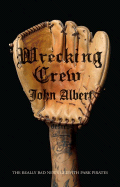 Wrecking Crew: The Really Bad News Griffith Park Pirates by John Albert
The Goods: Recovering junkies, failed rockers, struggling actors and other assorted misfits and miscreants band together to form an L.A. baseball team.
Thoughts: If you ever thought that trying heroin, dating a stripper, or moving to Los Angeles to 'make it' might be fun, after reading this book, you won't. But it will make you want to hit the batting cages, or at least play a good game of catch with your cross-dressing next-door neighbor.
Choice Moments:
"Jacob Hedman was still working days as a landscaper, snorting the occasional line of crystal meth, and planting shrubbery outside Kyle MacLachlan's home."
"When the Sex Pistols sang about 'no future,' someone should have warned these bastards that it was merely rebel agitprop and not a design for living."
"'L.A.'s a weird town that way. People seem to respect you more if you're an actress and just a prostitute on the side'"
"'Try not to fuck this up. Now come on and let's beat these dirty motherfuckers!' On that tearful note, we clasped hands, shouted, 'Pirates!' and sprinted onto the field to a smattering of applause and sarcastic comments."
"Sometimes our umpires were crackheads."
If You Like...: Please Kill Me: The Uncensored Oral History of Punk, feeling smug about not reading A Million Little Pieces, and find yourself sometimes strangely and unironically moved by inspirational sports stories, this book is for you.
Subscribe to:
Posts (Atom)

