Dear reader, life is too short for crap books.

Showing posts with label Film. Show all posts

Saturday, February 07, 2009

No Happy Endings: City of Nets by Otto Friedrich


City of Nets: A Portrait of Hollywood in the 1940s by Otto Friedrich

City of Nets begins with Sid Grauman, ends with Ronald Reagan, and in between, drops in on nearly every historical personality, event, and movement that figured into the tumultuous and transformative decade.

The title comes from Bertolt Brecht's libretto for The Rise and Fall of the City of Mahagonny, about a town of "gin and whiskey, girls and boys" that begins as a hedonist's paradise, but ultimately falls to destruction. Brecht himself turns up periodically in City of Nets, and his own Hollywood story is detailed by Friedrich. It's a doozy -- flight from Nazi Germany, various unsuccessful turns as a Hollywood screenwriters, and finally, a summons before HUAC.

There aren't very many happy, Hollywood endings for the people Friedrich writes about, but there are some great stories -- Bette Davis running the Hollywood Canteen; Olivia de Havilland's battles with Warner Brothers; the madcap life of Preston Sturges; the sad decline of Charlie Chaplin.

The book is also packed with stories of happy accidents, near-misses, and half-truths turned legend. Casablanca became one of the best-loved pictures of all time, despite the fact that no one involved with the film really wanted to be there. George Raft's inability to recognize a good role if it bit him on the face gave us Humphrey Bogart as Sam Spade and Fred MacMurry as Walter Neff. And it will probably never be known who really stole the body of John Barrymore and propped it up in Errol Flynn's favorite chair, but Friedrich tells both versions of the story.

And then there's the labor battles and the Hays Office, the War and the war at home, the Red Scare and HUAC. Chandler, Faulkner, and Billy Wilder's awesome telling-off of Louis B. Mayer.

There's never a dull page, and chances are you'll be loading movies into your Netflix queue the entire time. City of Nets provided my happy introduction to Preston Sturges's The Miracle of Morgan's Creek, which is a smart-assed finger in the eye of the Hays Code and just about the funniest thing I've ever seen besides.

Monday, May 19, 2008

A Quick Detour Into the Exciting World of Exploitation Film: She Shoulda Said No!

After reading about Evelyn Nesbit in American Eve, her story reminded me of another beautiful young woman sacrificed on the altar of fame and celebrity scandal, Lila Leeds.

At the beginning of 1948, Leeds was poised to take Hollywood by storm. She'd had a small role in Lady in the Lake, and her looks drew comparisons to Lana Turner and Jean Harlow.

But then police busted up a marijuana party at her Laurel Canyon cottage, hauling in Leeds, and much to their delight, Robert Mitchum. Mitchum and Leeds were both convicted and sentenced to 60 days in prison. Both feared their careers were over; when Mitchum was asked to state his occupation for the police report, he replied, "Former actor."

However, Mitchum's studio rallied around him, and though some disapproved, the arrest gave his bad boy reputation even more cred.

Things would not go so well for Leeds, who was thrown under the proverbial bus. Even her agent, Louis Shurr said, "She had a promising career and was headed for success, if she had only behaved differently. It looks now as though she's blown her chances sky high."

Still, Leeds got one little break after prison - the chance to star in a sensationalized anti-drug movie in the spirit of the oft-mocked Reefer Madness. There was some trouble settling on a title. It was initially called The Devil's Weed, and for its Los Angeles premiere, it was titled Wild Weed, but the title was eventually changed to She Shoulda Said No!.

And sure, it bears many classic marks of the anti-drug exploitation film: teens smoke a little pot, get frisky, and smash up their cars; people go into marijuana "withdrawal," and a jittery fellow tries to throw himself out a window. However, She Shoulda Said No! is actually a pretty little terrific film, mainly because of Leeds's performance.

Leeds plays Anne Lester, a good girl working as a dancer to put her lazy, mooching brother through art school. Of course, the friendly neighborhood drug dealer, Marky, stops by the dressing room to give the girls their fix, and wants to meet Anne the moment he lays eyes on her. One of Anne's dancer friends throws together an impromptu party, Marky gets Anne high, and before you can say Jack Robinson, she's his drug-dealing sidekick.

Leeds is perfectly lovely as a good girl, but it's once Anne Lester turns bad that the character really starts to shine.

When the cops try to pressure her into giving up Marky, Anne tells them where to stick it with such venom and contempt that it's almost like watching an interrogation scene from The Wire. Obviously, Leeds's memories of prison are still fresh here, but it's also clear that the gal has some acting chops.

In most movies like this, the Anne Lester character winds up a martyr, a junkie, a jailbird, or a repentent, wounded little sparrow, but She Shoulda Said No! avoids resigning her to any of these fates. And that's the best part of all.

Unfortunately, Leeds herself wouldn't be so lucky. Shortly after the release of She Shoulda Said No!, all the acting jobs dried up, and Leeds left California for over 15 years, during which time she was repeatedly arrested for drug possession and soliciting. For a time, she found an unlikely savior in the figure of Chicago madam Kay Jarrett, who helped Leeds hide from the press and care for her infant son shortly after she'd been abandoned by the child's father.

The story has a semi-happy ending, though I haven't yet uncovered the bulk of it. In the 1960s, Leeds returned to Los Angeles, sober and working as a minister with an evangelical church. She died in Canoga Park in 1999, and I'm still trying to fill in a lot of those missing years.

But in the meantime, add She Shoulda Said No! to your Netflix queue. You won't be disappointed.

Sunday, March 09, 2008

Like Something Out of Kafka

There are a few things for which I am grateful each and every day: family, friends, the critters, good health. In addition to these incredibly important, yet fairly typical things, I am constantly reminded how grateful I am that I am no longer a public school teacher.

From a recent episode of This American Life, I learned about "the Rubber Room," a sort of Kafkaesque holding pen for NYC public school teachers who are awaiting disciplinary hearings. They report here for the workday, and sit, doing absolutely nothing -- sometimes for months or even years. It is not required that they be told the charges against them.

Some of these teachers clearly should not be allowed back in the classroom, but some people are there on dubious charges, and some merely had personality conflicts with school administrators. Though the BOE won't discuss it, it is estimated that somewhere between 600-900 teachers are currently assigned to these facilities.

Five Boroughs Productions is currently making a documentary about it -- here's the trailer.


UPDATE: Ugh. As if I needed another reason to be grateful. Sure, my institution's materials budget may have been cut by 75% for the remainder of the fiscal year, but at least my job is safe.

Thursday, January 17, 2008

Charles Webb, You're Trying to Seduce Me

Home School by Charles Webb

Before The Graduate made Dustin Hoffman a star and Mrs. Robinson a household name, it was the first novel of a recent Ivy League graduate named Charles Webb. Published in 1963 to lukewarm reviews (the Los Angeles Times described it as "repetitive, pointlessly detailed melodrama," while others called it "inept" and "ridiculous"), Webb sold the film rights rather quickly. Unfortunately, he received only a one-time payment of $20,000 -- while the film went on to gross over $100 million.

Since The Graduate, Webb's unusual biography has eclipsed his literary career, the latter being steady, if relatively uncelebrated. And when it came out that Webb would publish a book that clued readers in to what became of Benjamin and Elaine after they hopped the Santa Barbara bus, folks pricked up their ears. However, once they got past the initial novelty of the book's premise, the reviews have not been kind.

And I suppose this one won't be either. However, it's got nothing on David L. Ulin's recent LAT review, quite possibly the most decisive pan I've ever seen in the book pages of a periodical.

Home School suffers from a lack of focus, silly 70s caricatures, and an artless over-reliance on dialogue. Benjamin is an insufferable, priggish dilettante, Elaine is a passive-aggressive shrew, and their children are annoyingly precocious. The cloying, manipulative Mrs. Robinson is far and away the book's most likeable character.

However, it is not without its redeeming qualities.

In fact, once I resigned myself to these problems, and to the fact that I wished painful and sustained misfortune upon each of the book's characters, I actually began to enjoy it a bit.

When the book begins, Elaine and Benjamin have moved to the other side of the country to escape Mrs. Robinson, and are illegally home schooling their children. Benjamin wants them to grow up without being poisoned by the institutions that led to his post-graduate shiftlessness. But eventually, the school system catches up with the Braddocks, and forces the children back into public school. Apparently, this is ominous enough a threat for Benjamin to contact Mrs. Robinson and ask for her help. But once Nan, as she's now called, is in their house, the problem becomes how to get her to leave.

Conveniently, it was right around this point that I made my peace with Home School, because Webb ratchets up the conflict, old secrets come out, and things get truly nasty.

While I can't entirely recommend Home School, the moment I learned of its existence, I set about tracking down a copy. And for curious fans of The Graduate, it's certainly worth checking out.

Some books shouldn't have sequels, simply because they end precisely where they ought to. If an archivist turned up a copy of a lost Flannery O'Connor story detailing the further adventures of the Misfit, I know it would be awful, as sure as I know I'd be first in line to read it. We ought to let (un)happily ever after well enough alone, yet morbid curiosity will always keep us turning the pages on literary icons.

Wednesday, November 21, 2007

nobody, not even the rain has such small hands

I couldn't suggest a finer accompaniment to your turkey coma tomorrow than Hannah and Her Sisters, one of Woody Allen's best and perhaps the greatest Thanksgiving movie ever made (granted, there's probably not a large pool of those).

In one of the most inept flirtations in screen history, Elliot (played by Michael Caine) buys Lee (the luminous Barbara Hershey) a collection of ee cummings poetry, saying that "I read a poem of you the other day and thought of him." Then tells her to read "somewhere i have never travelled". Smooth.

The film also contains one of my all-time favorite movie lines: "If Jesus came back and saw what's going on in his name, he'd never stop throwing up."

In the holiday recipe round-up today: no-knead dinner rolls and a pumpkin praline cheesecake that may just be the prettiest dessert I've ever seen.

Happy Thanksgiving, everybody!

UPDATE: Hannah and Her Sisters may be the post-dinner Thanksgiving movie, but the best Thanksgiving movie to put on while you're cooking is definitely The Last Waltz.

Monday, November 05, 2007

Bad Taste

It's literary week over at the Onion A.V. Club, and they're kicking it off with "20 Good Books Made Into Not-So-Good Movies", as well as an interview with Alice Sebold, whose The Lovely Bones is getting the Peter Jackson treatment at the moment.

I'm assuming it's going to be more the "Heavenly Creatures Peter Jackson" than "Dead Alive/Meet the Feebles/Lord of the Rings/King Kong Peter Jackson". Then again, I think we'd all agree that what the adaptation of Sebold's haunting novel really needs to make the transition from page to screen is a massive battle scene where the bereaved father takes on a horde of zombies, cannibal aliens, carnivorous worms, and very lewd muppets with a lawn mower.

Monday, July 16, 2007

Discuss.

How did we not hear of this?

1. I'm hoping that the director is really angry about the cheeze-tastic voice-over.

2. This could be very good, or it could really, really, really suck.

3. The casting seems pretty good for the most part, though I must admit to being a little surprised to see Electro-Thief-Gunn's-Rebound Lady from Angel cast as Chloe.

4. Bonus points for using the New Pornographers in the trailer.

Saturday, May 26, 2007

Hooray for Hollywood, Unless of Course They Mess It Up

I don't know who I need to talk to about this, but if someone is in fact going to make a film version of Ross MacDonald's The Galton Case, I'd like to write the screenplay. Because if Freudian flatfoot Lew Archer gets the Black Dahlia treatment, I don't know what I'd do. Maybe I'd chain myself to the Hollywood sign and go on a hunger strike, or sneak onto the Warner's lot and moon the responsible parties. Either way, it wouldn't be pretty.

Lunchtime poll for your inner Casting Director: We all know that Clive Owen was genetically engineered to play Chandler's Marlowe, but who should the Powers that Be tap to portray our favorite humanist shamus? I'm tempted to say Aaron Eckhart, but he's too smarmy. Maybe Gary Oldman could pull it off, if somebody kept him on a tight leash. (I would suggest Clarke "Lester Freamon" Peters from The Wire, but I'm saving him for Easy Rawlins.)

Thoughts?

Saturday, March 10, 2007

Proof That Everything Is Connected

In François Truffaut's remarkable movie about making movies, Day for Night, leading man Alphonse flees the set after experiencing emotional trauma, and is summarily rounded up at the go-karts.

In Kevin Smith's remarkable movie about making movies with your friends (and sneaking in digs at Peter Jackson), Clerks II, leading man Randal Graves flees Mooby's after experiencing emotional trauma, and is summarily rounded up at the go-karts.

Was this an homage to Truffaut, I wonder, or do go-karts just have some sort of universal "centering" effect of which I am unaware?

Monday, October 09, 2006

Suitable for Filming, But Not Filmed Yet

With the cost of living in Los Angeles being what it is, we are often forced to make our own fun here at the Potts/McCoy house. Sometimes we cook elaborate things or write or play Scrabble. And sometimes we have Craft Night.

Once, irritated by issues of co-opted "authenticity" in the art world, we invented an outsider artist named Caleb Doheny*. His seminal work, "Nehemiah 8:11," now serves as a book cover for my dictionary.

We also made a board game called Punk: The Game out of a cardboard box and some index cards. By role of the die, you become one of 6 punk band archetypes, and go on tour. Depending what cards you draw, you might get the clap, sell a bunch of t-shirts, or get in a fight with Richard Hell. Due to a completely unintentional, though seemingly genius, design flaw, it is almost impossible to finish the game with any money, although most players wind up in jail or the hospital at least once.

However, our traditional "quiet night at home" activity is the composition of the Top 5 list, a la High Fidelity. Last night's topic seemed semi-relevant for the blog, and since I'm between decent books right now, here's mine:

Top 5 Books That Should Be Adapted Into Film

5. the short stories of Tim Gautreaux (preferably done by Altman)
4. Triangle: The Fire That Changed America by David von Drehle
3. The Feast of Love by Charles Baxter
2. Ex Machina by Brian K. Vaughan
1. The Little Friend by Donna Tartt

Reading over this, I realize that the alleged "point" of this post did not exactly need the amount of lead-in I gave it. Still, I'm leaving it in. I hadn't thought about Punk: The Game in years, and now I kind of feel like playing it.
______________________________
* Caleb Doheny is a painter and collage artist from West Virginia. He began creating art after his wife, running off one night to meet her lover, drowned in the river. Ever since, he has woken up each morning and painted a picture of her before making up a cooler of ham sandwiches, which he drives up to logging sites and sells to lumberjacks. This is how he makes money to buy his art supplies. His canvases are paper bags. Doheny's admirers include Sean Penn, Jennifer Aniston, and JT LeRoy.

Sunday, September 17, 2006

Lost in Translation

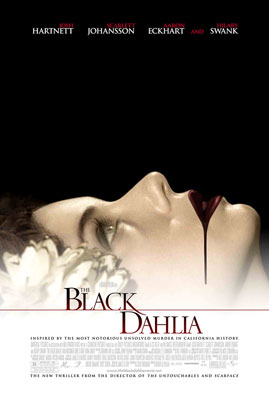
I went to see The Black Dahlia last night, and while it was a socially entertaining evening, I have to say that the movie itself was quite possibly the worst thing I have paid to see on the big screen since Spawn.

Sometimes, when you see a bad movie, you suffer alone. You spend your two hours* bashing your head against the back of the theatre seat and praying for it to be over. But sometimes you have a night like my experience at The Black Dahlia, where the entire audience turns on the film so completely that it seems as though it must have been planned in advance.

And that, my friends, is something to see.

It began during a scene when Scarlett Johansson appears at the top of a staircase in her underwear, scowling down at Josh Hartnett**. It was supposed to be dramatic, but the cut was so weird, and the expression on her face so goofy, that everybody in the audience just busted out laughing.

When Scarlett Johansson in her underwear elicits laughter, it's fair to say that your movie has problems.

From there on out, it was like we, as an audience, had forged some unwritten agreement that it was okay to call shenanigans on this crapper of a flick. We laughed in the wrong places for the wrong reasons. We yelled instructions to the characters onscreen. Some, including the gentleman seated next to me, voiced their displeasure loudly. His remark probably got a bigger laugh than anything that was intentionally written into the script.

People around the theatre were bashing their heads against the backs of their seats, praying for it to be over, but it was okay. Because we had spent $14 for our swanky Arclight seats, and we were all in this thing together.

As a sidenote, The Onion gave this thing a good review, lending credence to my long-standing theory that their film reviews should be lumped in with the satire section.

So yeah... don't go see this movie. Pick up James Ellroy's Dahlia instead. And if you've already seen Brian De Palma's monstrosity and need to calm down in a hurry, rent L.A. Confidential, watch until the giggling/rage subsides, repeat as needed.
------------------------------
* Who made the rule that all movies need to be at least 2 hours long? It's gotten out of control.
** This man is handsome, and his hard-boiled voiceovers in both Dahlia and Sin City are great. He has the face. He has the voice. Yet, something very, very important is missing.

Friday, August 18, 2006

Rich People Died

The Hollywood Book of Death by James Robert Parrish
Killing Yourself to Live: 85% of a True Story by Chuck Klosterman

A few years back, I worked as a volunteer manager for a traveling Titanic exhibit, and each and every weekend, thousands of well-fed tourists poured into the Memphis Pyramid to gawk at stuff, and generally make my life miserable. One day, after a particularly grueling shift during which a visitor handed me a headset, and said, "I threw up on this," I was complaining bitterly to a friend, and asked, "Why? Why do people insist on being interested in this gruesome spectacle?" She shrugged and said, "Rich people died."

And there you have it. So long as rich people die, people will insist on being interested in it, gawking at it, and books will be published about it. Bad experience aside, I am forced to admit that I, being no more noble than anyone else, am also interested in celebrity deaths. And living in Los Angeles, I certainly have access to a number of them. I can go to the Viper Room where River Phoenix overdosed or to the Biltmore Hotel, the last place Elizabeth "The Black Dahlia" Short was seen alive. Heck, if I walk four houses down from mine, I can see up into the apartment where a washed-up silent film star named Karl Dane blew his head off.

The Hollywood Book of Death is pretty straightforward - brief biographies of the famous, the obscure, and the tragic. The book is divided into chapters including "Drugs and Alcohol," "Murders," "Puzzling Deaths," and "Accidental Deaths," but despite its sensational subtitle, "The Bizarre and Often Sordid Passings of More Than 125 American Movie and TV Idols," the biggest hunk of the book is given over to "Natural Causes."

In addition to being sometimes sordid, it's a pretty well-researched little book that includes lots of tidbits I never knew (e.g. John Barrymore's drinking buddies Errol Flynn and Raoul Walsh swiped the body and played a little Weekend At Bernie's with it) and debunks lots of gossip I'd always believed (e.g. Jayne Mansfield was not, in fact, decapitated - her wig came off).

Killing Yourself To Live differs from The Hollywood Book of Death most significantly by not being remotely about what it purports to be about. Theoretically, Klosterman is on assignment with Spin, embarking on a whirlwind road trip across the United States to visit the sites of notable rock n' roll deaths. But pretty quickly, he realizes that nobody at the Chelsea Hotel wants to answer any more questions about what happened between Sid and Nancy in Room 100, that the swamp where Skynyrd's plane went down is infested with cottonmouths, and that when you go to the beanfield where the music died, there's really not a whole lot you can do except stand around in a beanfield.

As a result, Klosterman's whole experiment devolves into a memoir of music he's loved, women he's loved and lost, and sometimes both at the same time. At one point, he realizes that he is best able to understand the role that these women played in his life by casting them as various members of KISS. Hey, we've all done it (although maybe not with KISS).

Is this more than a little self-indulgent? You betcha. Does that make it a bad book? Not by a long shot. Klosterman perfectly captures what it's like to be in your early 20s, and even more perfectly, how hard it is to remember what that time was like once you're no longer in your early 20s, except that it was depressing, spent shiftlessly, and probably wasted on you. The book is quirky and funny, and filled with the kind of thoughts you have on a long car trip by yourself, if you are a music geek. How do I feel about Rod Stewart? Why does everyone go through a Led Zeppelin phase? What motivated Eric Clapton to steal his best friend's wife? Things like that.

If you want a celebrity fix, and are feeling shameless about it, go for The Hollywood Book of Death, but if you want to get some poignant reflection and pop culture nostalgia out of the deal, Killing Yourself To Live should be just the ticket.

Sunday, March 05, 2006

He Did It All*

In Black and White: The Life of Sammy Davis, Jr. by Wil Haygood

Tonight at the 78th Academy Awards, Hollywood got defensive. Although they cut off the producer of the Best Picture winner in the middle of her speech, time was set aside for a montage of epic films, the purpose of which was, I guess, to convince viewers at home that Netflix is a poor substitute for paying $10 to sit in uncomfortable chairs and eat cold popcorn with strangers.

After saluting his fellow nominees, George Clooney went on to get defensive about Hollywood's politics in his acceptance speech. And I was right on board until he lauded the Academy for giving Hattie McDaniel an Oscar in 1939 "when blacks were still sitting in the back of theatres." Apparently, Hattie McDaniel was initially seated in the back of the room the year she won the award (the producer of Gone With the Wind eventually arranged for her to be moved to a better table). I appreciate the sentiment behind Clooney's speech, but let's not kid ourselves and say that Hollywood is a great place to be a black actor.

Take a look at Sammy Davis, Jr., arguably the greatest performer and entertainer of the 20th century. His talents were limitless - actor, singer, comedian, impersonator, drummer, and dancer. He was the most literate member of the Rat Pack by a long shot, yet he never attended a day of school in his life. And Hollywood was not exactly sweet to him.

Haywood's biography doesn't spend much time on Davis's years with the Rat Pack, but treats extensively his lost childhood (he began performing in vaudeville shows when he was about 6), his Broadway career, and his struggles for acceptance in both the white and black community.

And Haywood's portrait (constructed out of exhaustive research and over 250 interviews) is not entirely flattering - Davis was immature, emotionally needy, insecure, a womanizer, an absent father, a spendthrift, a reluctant latecomer to the civil rights movement. But he was also generous, disciplined, and by all accounts, not a person who met him didn't instantly adore him. The best parts of the book detail Davis's stage performances. While it's no substitute for being in the audience at the Copacabana, the writing still leaves you breathless at the capacity of Davis's talent.

If you liked...: Rat Pack Confidential by Shawn Levy, Dorothy Dandridge by Donald Bogle, or books about the rise and fall of vaudeville, soft-shoe, and great nightclub performers, this book is for you.
__________________________
* Inscription on Davis's gravestone